
Life in the Wild and Fur Farms
Conditions in the Wild and on Fur Farms
In order to assess what suffering animals experience on fur farms, it is essential to compare the natural environment of the animals with the conditions on the fur farms. Minks and foxes are the animals most often reared for fur. These species are not domesticated and when in captivity suffer psychological and physical torture. Assertions that the behaviour and requirements of these animals have changed over the years are wrong and without scientific basis. Foxes and minks have been kept on fur farms for too short a time for any significant selection work to have been carried out; for this reason their instincts and basic requirements have not changed.
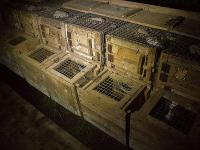
Fur bearing animals raised for the production of clothing are kept in tiny cages and suffer from injuries, physical deformities and psychological problems. Observations have revealed apathy and unnatural behaviour that are caused by the stress and psychological suffering brought on by their confinement. Foxes and minks carry out repetitive movements for long periods, this being a serious sign that an animal is feeling stress. It might be thought that animals on fur farms live a problem free life or even that they are satisfied, because they don’t have to struggle to survive and find food on their own. However, in their tight confinement the animals are denied expression of instinctive behaviour, and this creates chronic stress and frustration. This in turn causes the animals to fall victim to mental illnesses, which manifest themselves as apathy, aimless stereotypic behaviours, aggression towards other animals and self-mutilation, as well as cannibalism.
Foxes and minks are carnivores with well-developed senses that allow the location and capture of prey. The animals on fur farms are fed meat and fish offal, which has to be carefully processed to prevent them falling ill after they have eaten it. The constituent parts are ground into a paste and set amounts placed on each cage.
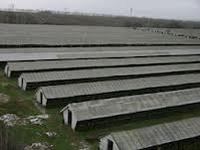
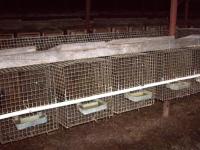
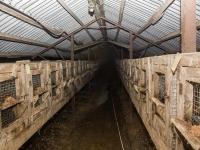
Farmed minks and foxes are kept in long open sided sheds in cages placed, one against the other, in two rows along each side of the shed. Fur farm workers use a passage, which is about a metre wide and runs between these two rows, to reach the animals. The open sided sheds are usually 50-100 metres in length. The bottom of a cage consists of grating to make it easier for workers to collect the animal excrement, which builds up under the cages; collection takes place once or twice a year. This wire mesh “floor” is, however, unsuitable for any animal, and, because of the excrement, the animals are forced to live their whole lives in a permanent stench. This type of open sided shed tends not to protect the animals from unfavourable weather conditions. In hot summer days minks may die from overheating, while in the months of autumn and winter they tend to be exposed to wind, rain and cold.
Because the priority of the fur industry is to generate income and reduce expenditure, it is impossible to secure conditions where foxes and minks would not have to endure psychological or physical suffering. For this reason fur farming is banned in many countries.
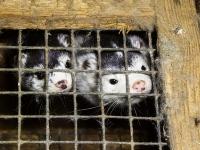
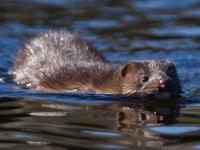
Mink have been bred in captivity for only about 80 years, and therefore cannot be considered domesticated by any stretch of the imagination. Minks are solitary animals, for whom a territory of their own is very important, and they defend their territories against members of their own species aggressively. On fur farms, however, as many as three minks may be kept in a single cage. In the wild minks daily wander around a territory which is several square kilometres in area. They live in wooded regions with nearby bodies of water, for example rivers or lakes. In such territories several burrows are excavated, and these are used often. Minks spend about half their time in water, swimming about 250 m each day and hunting water animals. Studies indicate that access to water is extremely important for minks because, being partly aquatic animals, they are in fact most active in water, and obtain up to 70% of their food there. However, on fur farms, the only available water is in the animal watering system or maybe a small drinking water bowl, where it freezes during low air temperatures in autumn and winter. Hence the conditions on fur farms cannot satisfy the basic needs of the minks. Minks which live in captivity are denied their natural behaviour because the whole of their short lives are spent trapped in a small cage (a cage with an area of 0.3m2, which is comparable to two shoe boxes). Here they cannot follow their instincts. The tiny size of the cage and proximity of other minks causes stress because in the wild minks associate with other minks only during the mating period. As a result minks injure themselves, gnawing at their own tails, or maim other minks with which they have been confined in the same cage.
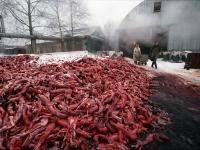
On mink farms mink pups are born from April to May, are separated from their mother when they are 6-8 weeks old, and after that are raised until November or December, when they are killed. In Latvia minks are suffocated with Carbon Dioxide, the animal having been transferred into a special chamber. In the 2001 European Commission report on the welfare of fur animals it was pointed out that this killing method is not desirable, because the animals remain conscious for a long time and die in great stress. For a single fur coat about 60 minks are killed.
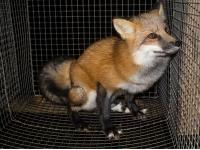
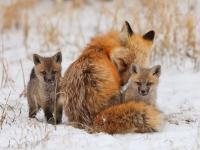
Foxes have been raised in captivity for about 100 years. However, during this time animals for breeding have been selected mainly for fur quality, and body and new-born pup size, without particular attention being paid to their relationship with man. Foxes have a great fear of man, and therefore suffer great stress if forced to live on fur farms or proximity to man. It has been observed that when a human approaches a fox’s cage, the animal, in its fear, tries to retreat as far as possible to the back of the cage. Foxes, in similar fashion to mink, will mark out territories in the wild, and, within the context of their species, hierarchy is characteristic. Wild foxes create complex burrow systems with several entrances and exits, and on fur farms exhibit instinctive burrowing behaviour against the wire of their cages. Foxes generally live within a territory which is up to 30 km2 in area, or larger still in the case of arctic foxes. They like to run and to cover great distances (up to 10 km per day). In contrast, on fur farms each fox is given less than a square metre in its cage. Because the cages are too small to allow them to move normally, it is not uncommon for their legs to become deformed from insufficient movement. Foxes on fur farms are subjected to enormous suffering because they cannot run, dig burrows, hunt, hide. For this reason the animals circle aimlessly, pace back and forth, jump from one corner of their cage to another, and gnaw at the wires of their cages, all the while trying to cope with the conditions of this captivity in which their instincts are suppressed.
In November or December, when the foxes are approximately half a year old, they are killed after the insertion of a metal rod in the anal orifice, the rod giving an electric shock. This method is beneficial for fur farmers because the fur isn’t damaged, but cannot be regarded as painless. About 10 foxes are killed for one fur coat. However, in the main, the pelts are used merely for the manufacture of collars and other smaller articles.
Other animals which are raised on European farms for their fur include rabbits, racoon dogs and chinchillas. The farming of chinchillas is particularly relevant to Latvia, because the number of chinchilla farms has risen rapidly in recent years, reaching about 25.
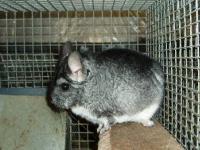
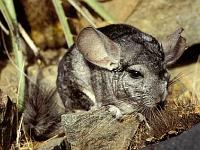
Chinchillas are social animals, which live in colonies. They are active mainly at night, and inhabit mountainous areas. Nowadays chinchillas are popular pets, although they do not like being touched by humans - this makes them nervous. The human use of chinchilla fur began centuries ago because these small rodents have unusually soft and fine coats, this making them particularly attractive to those who covet furs. As a result, one species of chinchilla is extinct, while the other two are protected. However, this does not save them from humans – at present chinchillas are found in Chile in the wild, where their illegal hunting continues.
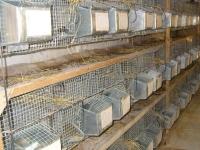
On Latvian fur farms it is permitted to keep two chinchillas in a tiny 0.2 m2 cage. The cages are usually laid out one against the other in rows, and piled-up several levels high. However, chinchillas are animals which naturally often move about, and have a natural urge to run; they can jump higher than one metre. Being rodents, chinchillas have constantly growing front teeth, which need to be worn down. Therefore, animals that are grown in captivity must have this need artificially met - hence the putting of twigs in cages.
About 150 chinchillas are killed to produce a single fur coat. In Latvia it is permitted to kill chinchillas in special chambers, poisoning them with chloroform or carbon dioxide. This is a beneficial killing method for the farmers because the valuable fur is not damaged. Needless to say, the method isn’t “humane” or painless. However, this doesn’t bother the farmers because in the economic area of fur production profit is what is most important.
Please sign the citizen intiative to end the cruel fur trade in Latvia!